
Ask three freight providers to quote the same two pallets from Melbourne to Brisbane and you'll probably get three different numbers. That's not always because someone is overcharging. Each quote is built from the same handful of ingredients, but providers weigh them differently, and small details in what you tell them can move the price a long way.
Once you know what those ingredients are, freight pricing gets much easier to read. Here's what goes into an Australian road freight rate, in roughly the order it gets built, and what you can check when a quote looks wrong.
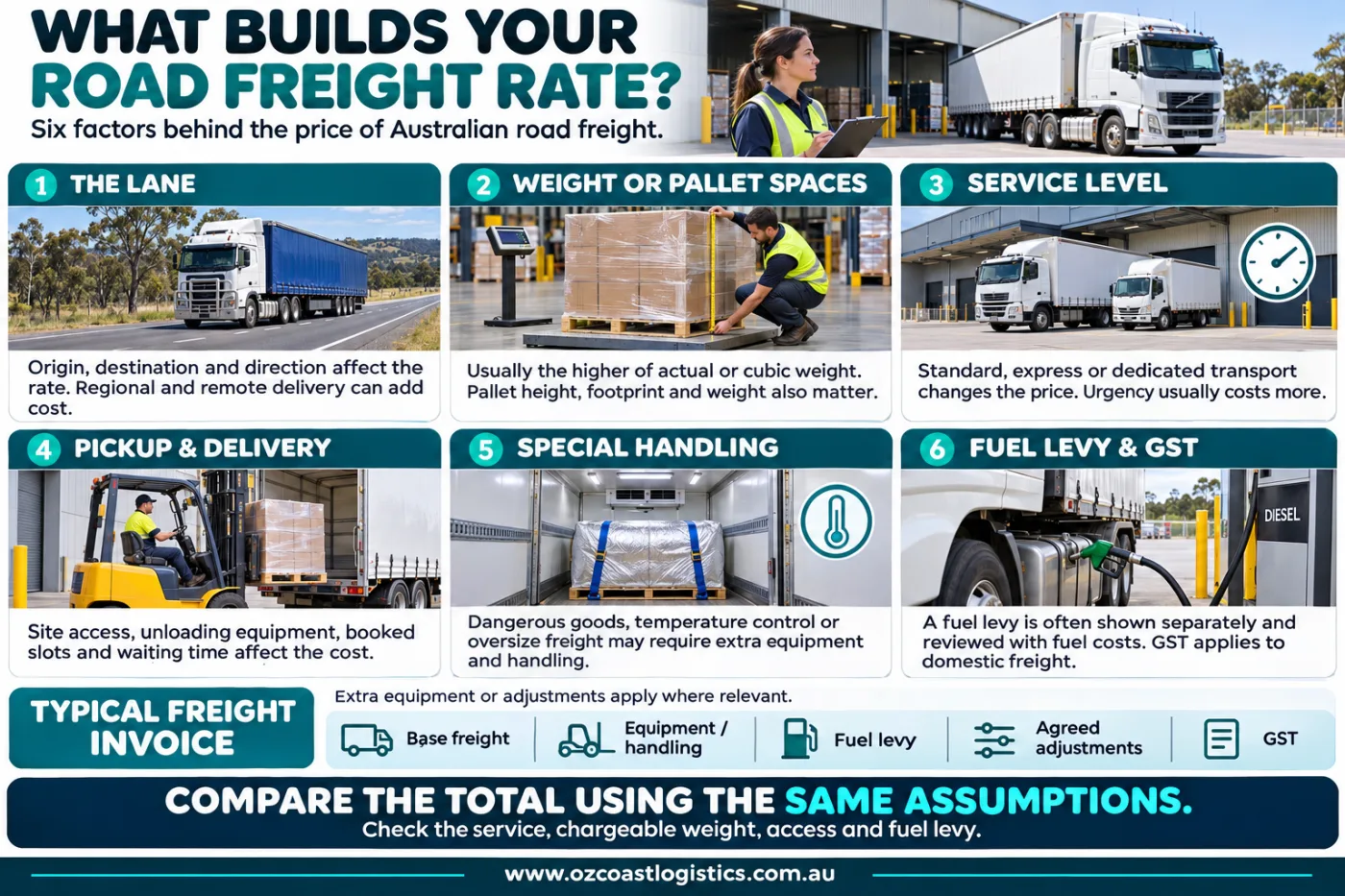
1. The Lane: Where It's Going From and To
The starting point of any road freight price is the lane, the origin and destination. Distance matters, but it isn't the whole story.
- Busy corridors cost less per kilometre. Lanes with heavy, regular freight flows, such as the east coast capital-to-capital routes, have frequent departures and full trucks, which keeps rates competitive.
- Thin lanes cost more. Fewer departures and less freight to share the truck mean each consignment carries more of the cost.
- Direction can matter. On some lanes far more freight moves one way than the other, so carriers may price the two directions differently. A rate from A to B doesn't always tell you the rate from B to A.
- Regional and remote delivery adds cost after the linehaul. The last leg to a small town is often run less frequently and over longer distances than a metro delivery.
Our guide to linehaul explains how the long-distance leg and the local legs at each end fit together.
2. Chargeable Weight or Pallet Spaces
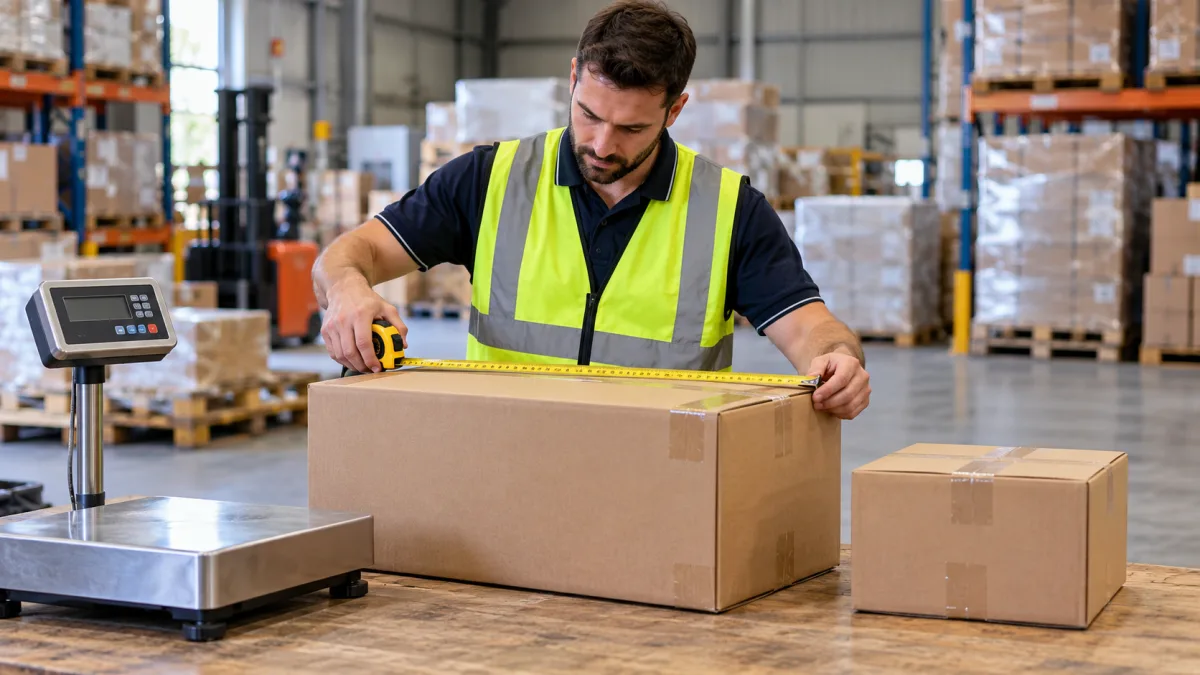
Next comes how much of the truck you're using. Road freight is usually priced on whichever is greater, the actual (dead) weight or the cubic weight, which converts volume into a notional weight. Bulky light freight pays for the space it takes up. Dense heavy freight pays for its weight. Our cubic weight guide works through the formula with examples.
For pallet freight, many quotes are based on pallet spaces, but height, footprint and weight still decide whether a pallet counts as a standard space. Over-height or over-width pallets use more of the truck and are priced accordingly. Remember the pallet itself counts. A standard timber pallet weighs around 35 to 40 kg empty, as our pallet weight guide explains.
Inaccurate dimensions or weights are the most common reason a final invoice is higher than the quote. Depots measure and weigh freight as it moves through, and the charge is adjusted to match.
3. Service Level
The same freight on the same lane costs more when it has to arrive sooner.
- Standard road freight moves on scheduled departures and is the most economical option.
- Express or priority services cost more because the freight gets priority handling, earlier departures or a dedicated vehicle. On longer runs that can mean two drivers sharing the driving so the truck keeps moving.
- Dedicated or full-load services price the vehicle rather than the space you use, which can be very good value for large consignments and expensive for small ones.
4. Pickup and Delivery Conditions
Conditions at each end of the job affect the vehicle, the time and the people involved:
- Equipment. No forklift on site means a tail-lift truck. A container without a dock may need a side loader. Specialised equipment changes the vehicle, and the rate. Our posts on tailgate delivery and container side loaders cover both.
- Access. Tight sites, residential streets and restricted delivery windows can all take extra time.
- Booked time slots and waiting time. Distribution centres often require booked delivery slots. A truck held up waiting to unload is a cost someone has to carry.
- Failed deliveries. If no one is there to receive the freight, the redelivery is effectively a second job.
These aren't always separate lines on a quote, but they're always part of the cost. Telling your provider about them up front gets them priced properly the first time.
5. Special Handling
Some freight carries obligations or equipment costs that ordinary freight doesn't:
- Dangerous goods need correct classification, documentation and segregation, and larger loads become placarded loads with extra requirements.
- Temperature-controlled freight needs a refrigerated vehicle, which costs more to run than a dry van.
- Oversize loads can need permits, route assessments and pilot vehicles. Our guide to oversize load rules explains the thresholds.
6. Fuel Levy and Other Charges
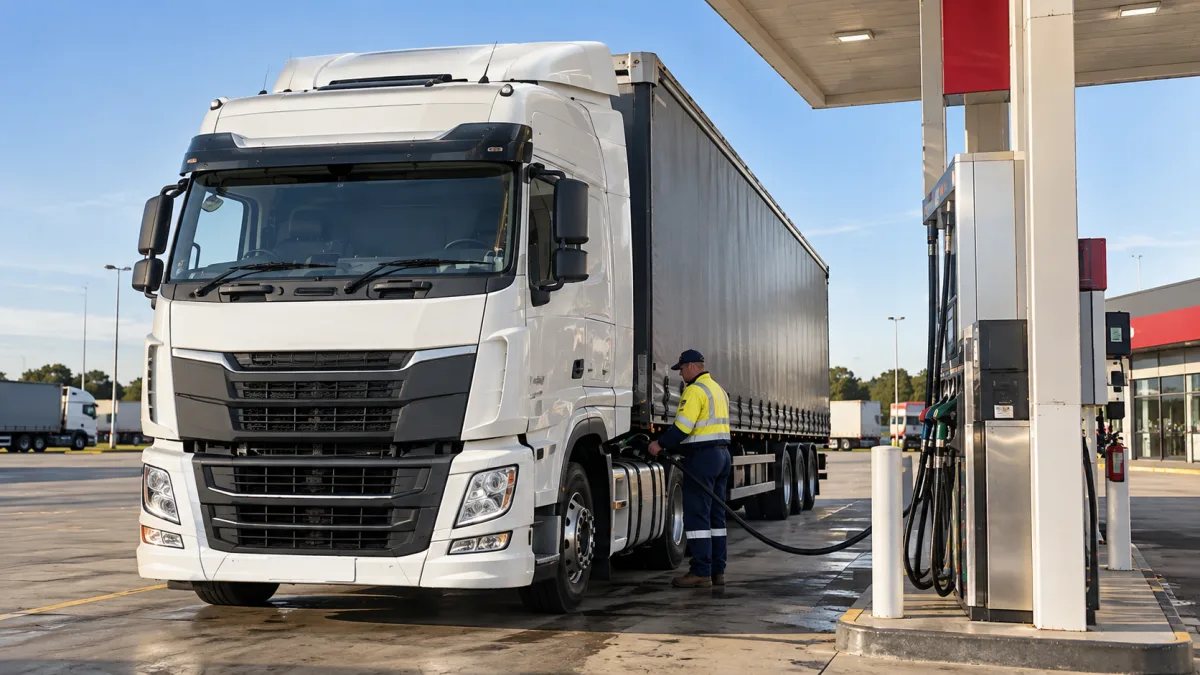
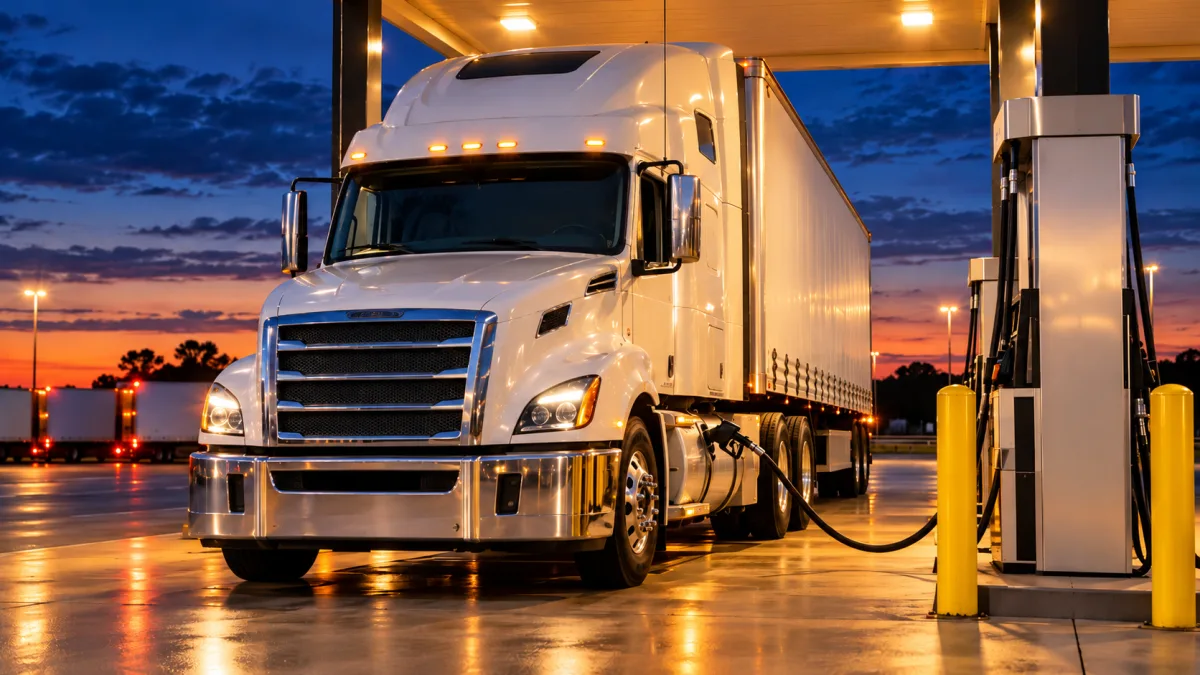
Most road freight quotes include a fuel levy, a charge that moves with diesel costs and is reviewed on a regular cycle. It's usually shown as its own line, calculated on the freight charge. Our fuel levy explainer covers how it works. Underneath it sits the heavy vehicle road user charge, a federal charge on heavy vehicle fuel that changed several times during 2026, as our road user charge guide explains.
GST then applies to domestic freight charges in the usual way.
What a Freight Invoice Typically Looks Like
Laid out as an invoice, a straightforward interstate pallet consignment usually looks something like this:
| Line | What it covers |
|---|---|
| Base freight charge | The lane, service level and chargeable weight or pallet spaces |
| Special equipment or handling | For example, a tail-lift delivery or dangerous goods handling, where applicable |
| Fuel levy | A charge on the freight, reviewed against fuel costs |
| Any adjustments | For example, re-measured dimensions, or waiting time where agreed |
| GST | Applied to the total |
If a quote rolls everything into one figure, ask for the lines. If an invoice has lines you didn't expect, ask what triggered them. Both questions are reasonable, and the answers usually point straight at the detail that changed.

Why Two Quotes for the Same Freight Differ
When two quotes for the same job are far apart, it's usually one of these:
- Different chargeable weight. One provider used a different cubic conversion factor, or applied pallet-space pricing where the other used weight.
- Different service level. One quote is express, the other standard.
- Different assumptions about access. One included a tail-lift, the other assumed a forklift at the delivery end.
- Fuel levy shown or hidden. One quote shows the levy as a separate line, the other builds it into a lower-looking base rate, or leaves it off the quote altogether.
- Different lane strength. One provider has a lot of freight on that lane, the other doesn't.
Compare quotes on the total, for the same assumptions, and you'll usually find most of the gap.
Getting a Quote That Holds Up
The more accurate the details at quote stage, the closer the invoice will be to the quote:
- Pickup and delivery suburbs, and whether either is residential or regional
- Number of items or pallets, with the dimensions and weight of each, measured with the pallet base included
- Whether anything can't be stacked
- Dangerous goods details, if any
- Equipment at each end: forklift, dock, or neither
- Any time windows, booking requirements or deadlines
If you're trying to bring the total down rather than understand it, our guide to reducing freight costs covers consolidation, packaging and scheduling.
How Ozcoast Quotes
Our interstate and intrastate freight pricing is built on the factors above: the lane, cubic or dead weight, service level, special equipment, and fuel levies and surcharges. We provide itemised quotes, so you can see what you're paying for, with the fuel levy shown as its own line rather than hidden in the rate. Send us the details above and we'll give you a quote you can compare like for like.