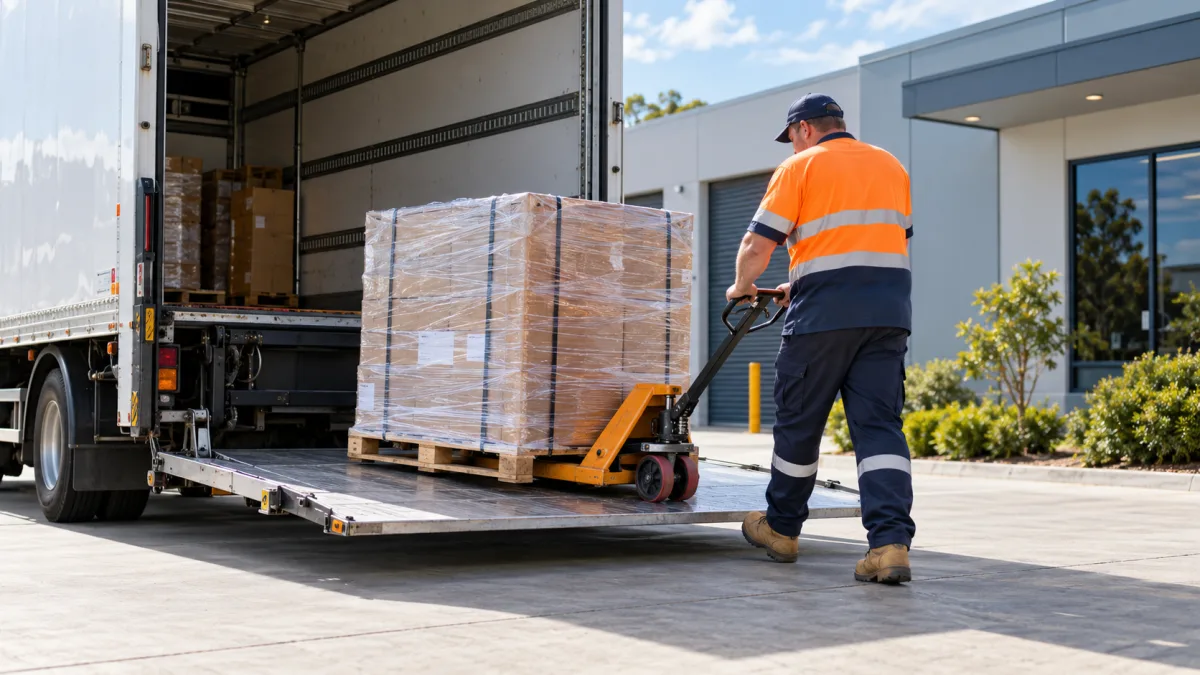
A pallet sitting on a truck deck about a metre off the ground is only useful if there's a way to get it down. Warehouses have loading docks and forklifts for that. A lot of delivery points don't: a retail shopfront, a small workshop, a building site, a regional business with a gravel yard and no machinery. That's the gap tailgate delivery fills, and it's one of the most common reasons a pallet delivery goes wrong when nobody mentions it at booking.
Do You Need a Tailgate Delivery? A Quick Guide
| Your delivery site has... | Tailgate delivery needed? |
|---|---|
| A loading dock at truck-deck height | Usually no |
| A forklift and someone to operate it on arrival | Usually no |
| No forklift, no dock, flat hard ground | Yes |
| No forklift, sloped or soft ground | A tail lift may not be safe, discuss before booking |
| Freight heavier than a typical tail lift can carry | No, a different unloading method is needed |
| Residential or small commercial address | Almost always yes |
If you're unsure which row you fall into, assume you need one and say so when you book. Arranging a tail-lift truck in advance is simple. Discovering the need when the truck is already parked outside is where delays and redelivery costs come from.
What Tailgate Delivery Actually Is
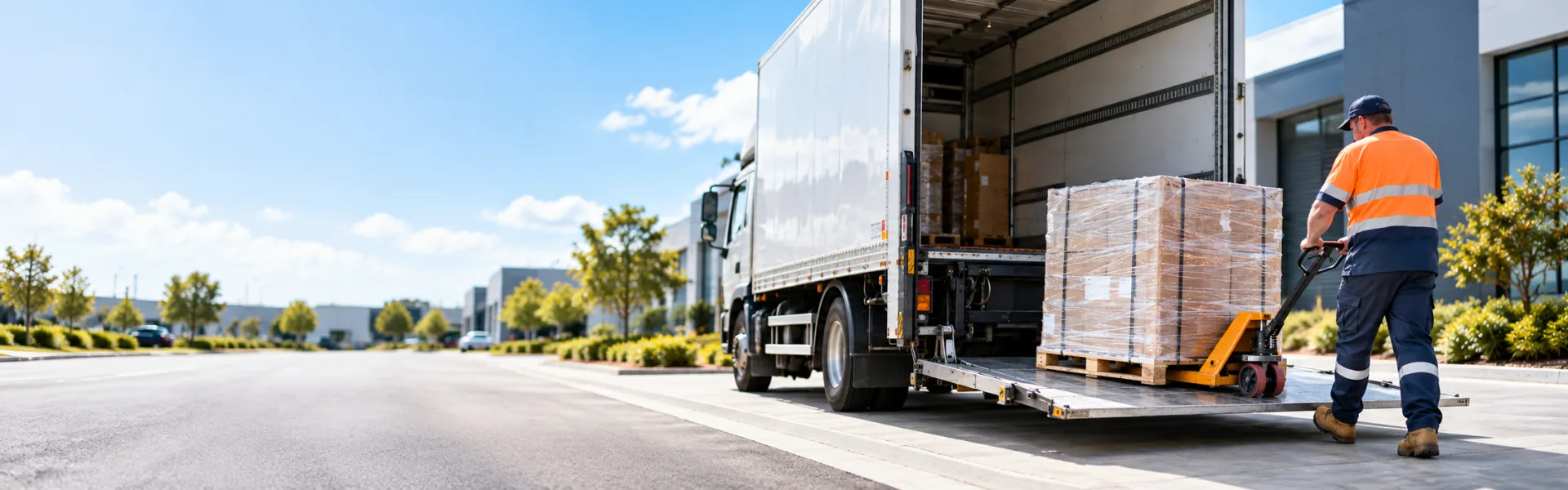
Tailgate delivery, also called tail-lift delivery (and liftgate delivery in the US), uses a hydraulic platform fitted to the rear of the truck. The driver moves the freight onto the platform, the platform lowers to ground level, and the freight is rolled off. No forklift or dock is needed at the receiving end.
The important detail is that not every truck has one. Tail lifts are fitted to specific vehicles, usually rigid trucks used for metro and regional delivery work, so a tailgate delivery has to be requested when the job is booked. It isn't something a driver can add on the day if the truck assigned to the run doesn't have the equipment.
What Your Site Needs for a Tail Lift to Work
A tail lift solves the height problem, not the ground problem. For the delivery to be done safely, the area behind the truck needs:
- A flat, level surface. A tail lift lowers freight straight down. On a slope, a loaded pallet can roll once it's off the platform, which is a genuine safety risk.
- A hard surface. Concrete or bitumen is ideal. Gravel, grass, sand or soft ground make it difficult or impossible to move a loaded pallet once it's on the ground.
- Enough room behind the truck for the platform to lower fully and for the freight to be rolled clear of it.
- Truck access. A tail-lift truck is still a truck. Low awnings, tight driveways and restricted street parking can all rule out a particular address, so mention them upfront.
If any of these aren't possible, say so at booking. There's often a workable alternative, a different set-down point on the property or a different unloading method, but it needs to be planned, not improvised.
What Happens Once the Freight Is on the Ground
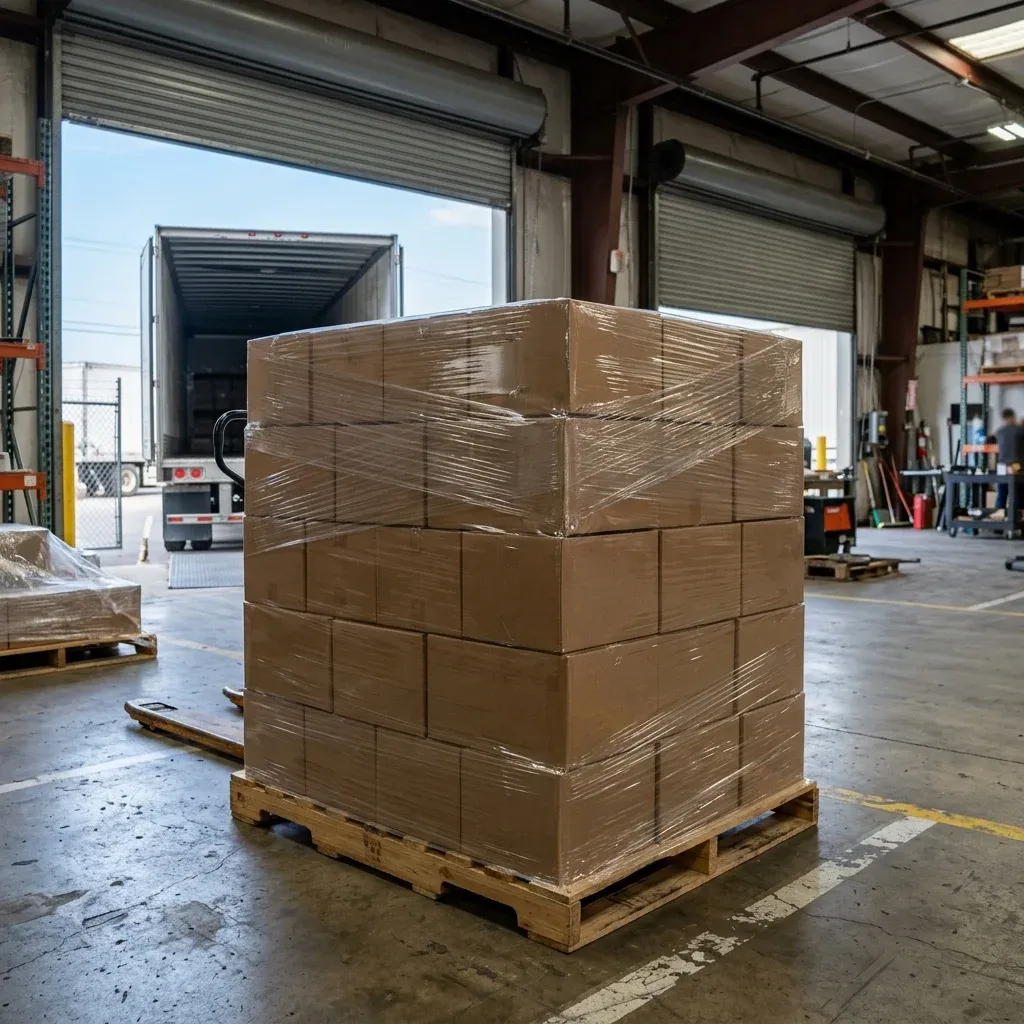
This is where expectations most often don't match what actually happens. A tailgate delivery gets freight from the truck deck to ground level at the delivery point, typically at the kerb or the nearest accessible hard-standing area. It doesn't automatically include moving the pallet inside a building, up steps, or through doorways.
Moving a pallet across the ground once it's down usually needs a pallet jack, and a loaded pallet on a pallet jack still needs a smooth, level path to wherever it's going. If you need freight taken further than the set-down point, or you don't have a pallet jack of your own, confirm what's included before the job is booked rather than assuming.
Where Tail Lifts Reach Their Limits
Tail lifts have a rated lifting capacity, and it varies considerably from truck to truck. A lighter delivery truck's lift is rated for much less than one fitted to a larger rigid truck, so a pallet that's fine for one vehicle can be over the limit for another. The practical consequences:
- Very heavy single items, dense machinery, stone, steel, can exceed what a tail lift is rated to carry.
- Oversized or unusually long items may not fit on the platform safely even if the weight is within range.
- Unstable loads, tall, top-heavy or poorly wrapped pallets, are riskier on a moving platform than on a forklift.
This is why accurate weight and dimensions at quote stage matter so much. They're what determine whether a tail lift can do the job at all. Correct packing helps too, a well-wrapped, stable pallet on a standard base (see our guide to standard pallet dimensions in Australia) is far easier to handle safely on a platform than an irregular one.
Tail Lift vs Forklift vs Crane Truck
| Method | Best for | Needs at the delivery site |
|---|---|---|
| Tail-lift truck | Standard pallets and bulky goods to sites with no dock or forklift | Flat, hard ground and space behind the truck |
| Forklift at the receiving end | Warehouses, yards and busy commercial sites | A forklift and a licensed operator available on arrival |
| Crane truck (often called a hiab) | Heavy or awkward items beyond a tail lift's capacity, or placing items over obstacles | Room to set up the crane and a clear lift path |
Each one solves a different problem. Picking the right one depends on what you're sending and what the site can support, not just on which is cheapest.
What to Tell Your Freight Provider When You Book
- That the delivery point has no forklift or loading dock, if that's the case
- The heaviest single item or pallet, and its dimensions
- The ground surface at the set-down point, and whether it slopes
- Any access issues: narrow driveways, low clearances, restricted parking, time windows
- Whether you need the freight moved beyond ground level, and whether you have a pallet jack
Five pieces of information, and the difference between a delivery that goes smoothly and one that turns into a second attempt.
Booking Tailgate Delivery With Ozcoast
Tail-lift trucks are part of our pallet delivery service, arranged at booking for sites without a dock or forklift. If you're not sure whether your delivery point needs one, or whether your freight is within what a tail lift can handle, tell us the weight, dimensions and site details when you request a quote and we'll confirm the right vehicle before the job goes out.