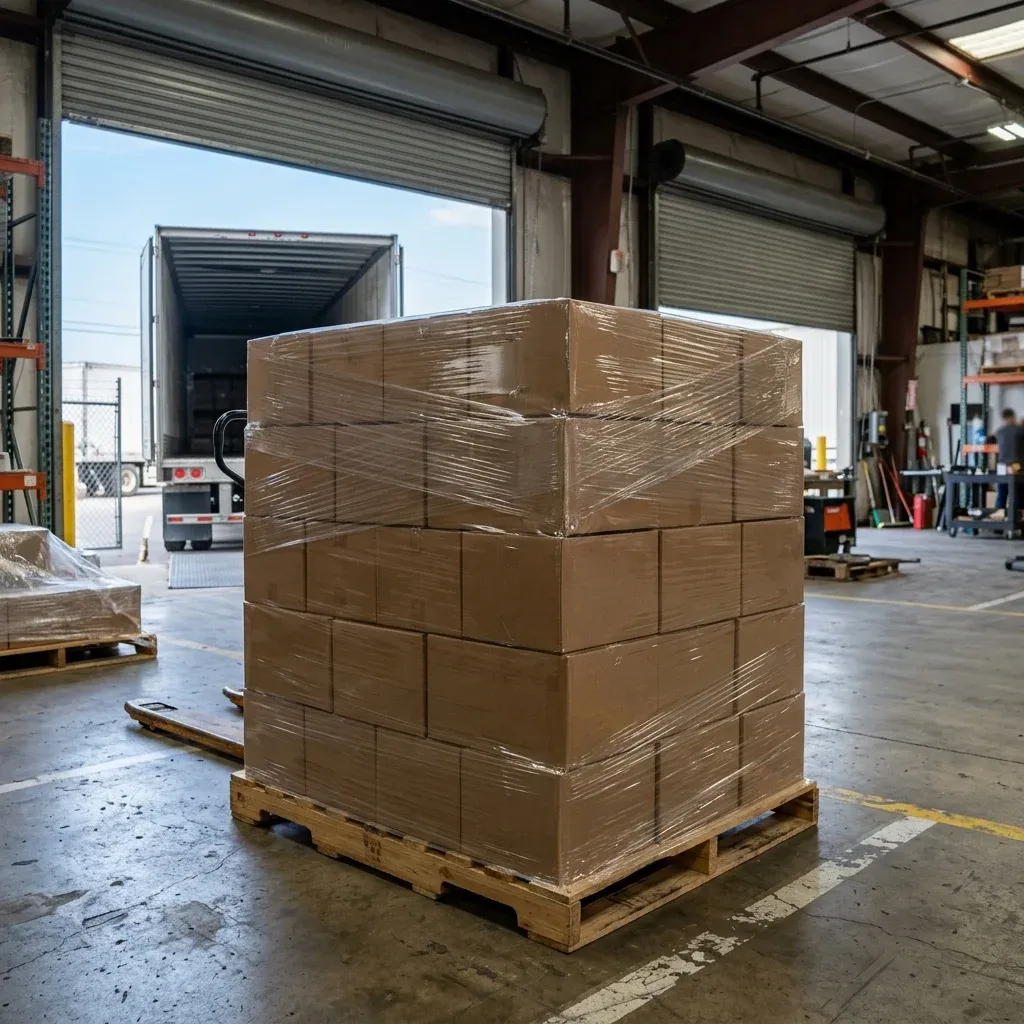


Put a carton of pillows and a carton of bolts side by side. Same size box, very different weight. On the scales, the bolts win easily. On the truck, they take up exactly the same amount of deck space, and space is what a linehaul trailer runs out of first when it's carrying light freight.
That's the problem cubic weight solves for carriers, and it's why a quote for a bulky but light consignment sometimes comes back higher than people expect. Once you understand how it's worked out, you can check your own quotes, spot errors on an invoice, and make packing decisions that actually reduce what you pay.
What Cubic Weight Actually Means
Cubic weight (also called volumetric weight) converts the space a piece of freight occupies into a notional weight in kilograms. The carrier then compares that figure with the item's actual weight on the scales, often called dead weight, and charges on whichever is higher. The higher of the two is your chargeable weight.
For dense freight, dead weight usually wins and cubic weight never comes into it. For light, bulky freight such as insulation, furniture, plastics, packaging materials or anything with a lot of air inside it, cubic weight is usually the number that sets the price.
How to Calculate Cubic Weight
The formula has three steps, and the only thing that trips people up is units.
- Measure length, width and height in metres. A carton that measures 60 cm is 0.6 m. Converting before you multiply avoids the most common mistake, which is multiplying centimetres and ending up with a number a million times too big.
- Multiply the three measurements together. The result is the volume in cubic metres (m³).
- Multiply the volume by the carrier's cubic conversion factor. The factor is expressed in kilograms per cubic metre. The result is the cubic weight in kilograms.
Then compare the cubic weight with the dead weight. Whichever is higher is what you're charged on.
The conversion factor is the part that changes between carriers and services, so it gets its own section below. For the examples, we'll use 250 kg per cubic metre, a factor that's widely used in Australian road freight and is the figure Australia Post publishes for its parcel services.
Example 1: A light carton
A carton of bedding measures 60 cm × 40 cm × 40 cm and weighs 9 kg.
- Volume: 0.6 × 0.4 × 0.4 = 0.096 m³
- Cubic weight: 0.096 × 250 = 24 kg
- Dead weight: 9 kg
- Chargeable weight: 24 kg
The carton is charged as if it weighed nearly three times what it does, because that's roughly how much truck space it uses relative to typical freight.
Example 2: A dense carton
A carton of fasteners measures 40 cm × 30 cm × 30 cm and weighs 22 kg.
- Volume: 0.4 × 0.3 × 0.3 = 0.036 m³
- Cubic weight: 0.036 × 250 = 9 kg
- Dead weight: 22 kg
- Chargeable weight: 22 kg
Here the scales win. No amount of repacking will reduce the charge much, because the freight is heavy for its size. This is why tiles, steel, stone and liquids are almost always charged on dead weight.
Example 3: A loaded pallet
A pallet of boxed homewares sits on a standard Australian pallet base (1165 mm × 1165 mm) and is stacked to a total height of 1.4 m, measured from the floor including the pallet itself. The whole thing weighs 380 kg.
- Volume: 1.165 × 1.165 × 1.4 = 1.90 m³ (rounded)
- Cubic weight: 1.90 × 250 = 475 kg
- Dead weight: 380 kg
- Chargeable weight: 475 kg
Two details matter in this example. The height includes the pallet base, which is usually around 150 mm and easy to forget. And the length and width are the pallet's footprint only if nothing hangs over the edge. If cartons overhang the base, measure to the outside of the cartons instead. Our guide to standard pallet dimensions in Australia covers the common footprints if you're not sure which base you're using.
Which Conversion Factor Applies?
There is no single national figure. The conversion factor is set by the carrier and can vary by service. In Australian road freight, the two factors you'll see quoted most often are 250 kg/m³ and 333 kg/m³.
The difference is bigger than it looks. Here's the same freight from the examples above at each factor:
| Freight | Volume | Cubic weight at 250 | Cubic weight at 333 | Dead weight |
|---|---|---|---|---|
| Light carton (Example 1) | 0.096 m³ | 24 kg | 32 kg | 9 kg |
| Dense carton (Example 2) | 0.036 m³ | 9 kg | 12 kg | 22 kg |
| Loaded pallet (Example 3) | 1.90 m³ | 475 kg | 633 kg | 380 kg |
A higher factor means a higher cubic weight for the same box, so light freight costs more under a higher factor. Dense freight is often unaffected either way, because its dead weight is still higher.
Three practical points follow from this:
- Comparing quotes on price per kilogram alone can mislead you. A lower rate per kilogram with a higher conversion factor can cost more overall on bulky freight. Compare the total for your actual consignment.
- Ask which factor applies before you book. If it isn't shown on your quote, ask. It's a reasonable question and any freight provider should be able to answer it.
- Check which transport mode a figure refers to. Conversion factors published online for other transport modes aren't the same as those used for road freight, so a calculator built for something else will give you the wrong answer for a truck.
Measuring Freight So the Numbers Hold Up
Cubic weight is only as accurate as the measurements behind it. A few habits prevent most disputes:
- Measure at the widest points. For an irregular item, measure the smallest box it would fit inside: its longest length, widest width and tallest height. Carriers charge for the space an item occupies, and an odd shape still blocks out a rectangle of deck space.
- Include everything that travels. Pallet bases, skids, crates, protruding handles and anything strapped to the outside all count.
- Don't round down. Measure to the nearest centimetre. A carton recorded as 50 cm that's actually 52 cm adds up quickly across a consignment of a few hundred cartons.
- Measure different items separately. If a consignment has several carton sizes, calculate each size and add them up rather than averaging.
- Weigh on reliable scales. A bathroom scale under a heavy carton isn't going to give you a figure you'd want to defend later.
Non-stackable freight
If a pallet or item can't have anything placed on top of it, some carriers charge for more height than it physically has, because the space above it on the trailer can't be used for other freight. If your freight is fragile, has an irregular top or is labelled "do not stack", say so at booking so the quote reflects it. Finding out afterwards is how surprise charges happen.
When the Invoice Doesn't Match the Booking
Many depots measure and weigh freight as it moves through, and if the actual dimensions or weight differ from what was declared at booking, the charge is adjusted to match. These adjustments are one of the most common reasons a final freight invoice is higher than the quote.
The fix is simple but it has to be done every time: measure and weigh before booking, and make sure the figures on the consignment note match the freight that's actually handed over. If you ship the same products regularly, keep a list of standard carton dimensions and packed weights so dispatch staff aren't guessing. Accurate details also matter beyond price, because mass and dimensions feed into how a load is planned and restrained on the vehicle.
Keep in mind that other charges sit on top of the base freight charge. A fuel levy, for example, is applied in addition to the charge worked out from your chargeable weight, so an error in cubic weight flows through to those charges too.
How Pallet Freight Fits In
Pallet freight is often quoted per pallet space rather than purely per kilogram, particularly for full or near-full pallets on interstate lanes. That doesn't make cubic weight irrelevant. Height, weight and footprint still decide if your pallet counts as a standard space or something more. An over-height or over-width pallet takes up more of the truck, so it's priced accordingly, and a pallet that's very heavy for its size may be priced on weight.
If you're sending a mix of loose cartons, it's worth asking whether consolidating them onto a pallet changes the price. Sometimes it does, sometimes it doesn't, and the only way to know is to get both options quoted. Our guide to preparing goods for pallet delivery covers how to build a pallet that stays square and inside its footprint.
Ways to Bring Cubic Weight Down
You can't change what your product weighs, but you often have more control over its volume than you'd think:
- Right-size cartons. A box that's 10 cm too tall in every direction is paying for air. For products you ship often, a better-fitting carton can pay for itself quickly.
- Cut down void fill. Protect the product, but loose fill in a carton that's twice the size it needs to be is the most expensive packaging you'll ever buy.
- Flat-pack where the product allows it. Items shipped assembled can occupy several times the volume of the same items shipped flat.
- Stack pallets square and to the edges. A pallet stacked to its full footprint but kept lower is often cheaper than a narrow, tall stack of the same cartons, and it travels more safely.
- Consolidate small consignments. Several small cartons sent on different days usually cost more than the same cartons sent together. Our How to Reduce Freight Costs guide covers consolidation and scheduling in more detail.
One thing not to do is under-declare dimensions to get a lower quote. The freight will be measured along the way, the charge will be adjusted, and inaccurate details can also affect how the load is planned and handled.
Getting an Accurate Quote From Ozcoast
For pallet delivery and general freight across our national network, the quickest way to get a quote that holds up is to send the details that decide chargeable weight in the first place: the number of items or pallets, the dimensions of each, the weight of each, whether anything can't be stacked, and the pickup and delivery suburbs. With those in hand we can give you an itemised estimate, and if you want to know which conversion factor applies to your freight, ask and we'll tell you.
If you're not sure how to measure something awkward, describe it or send a photo with a tape measure in shot. It's much easier to sort out before pickup than after the invoice arrives.