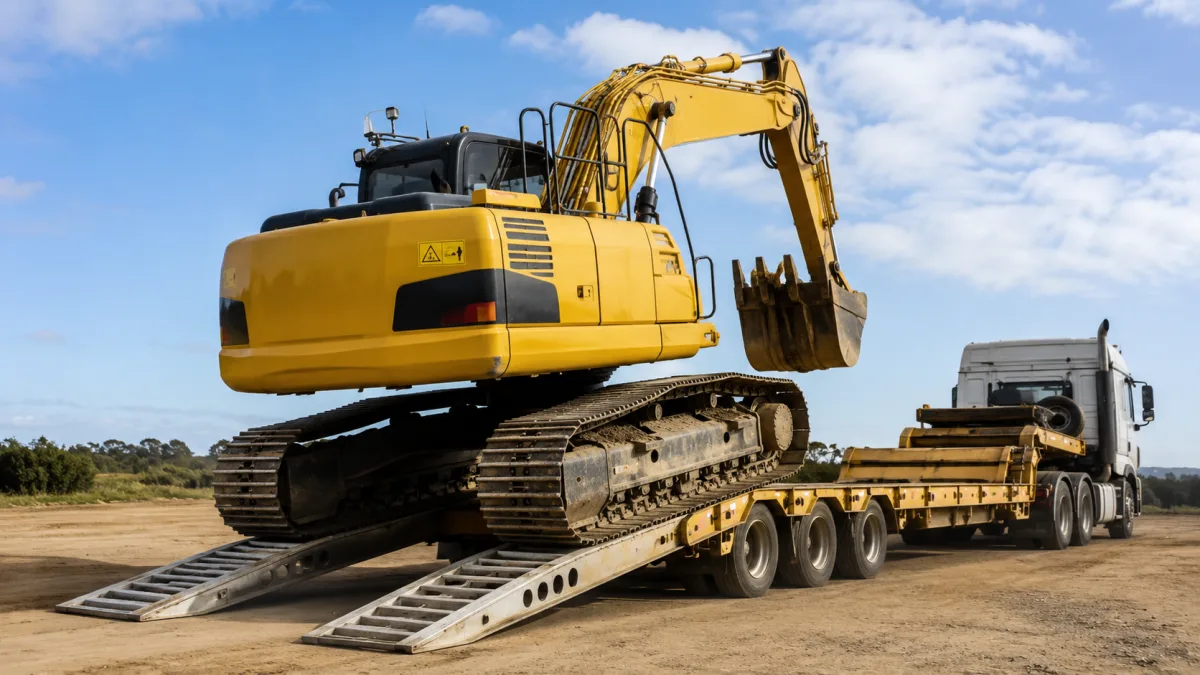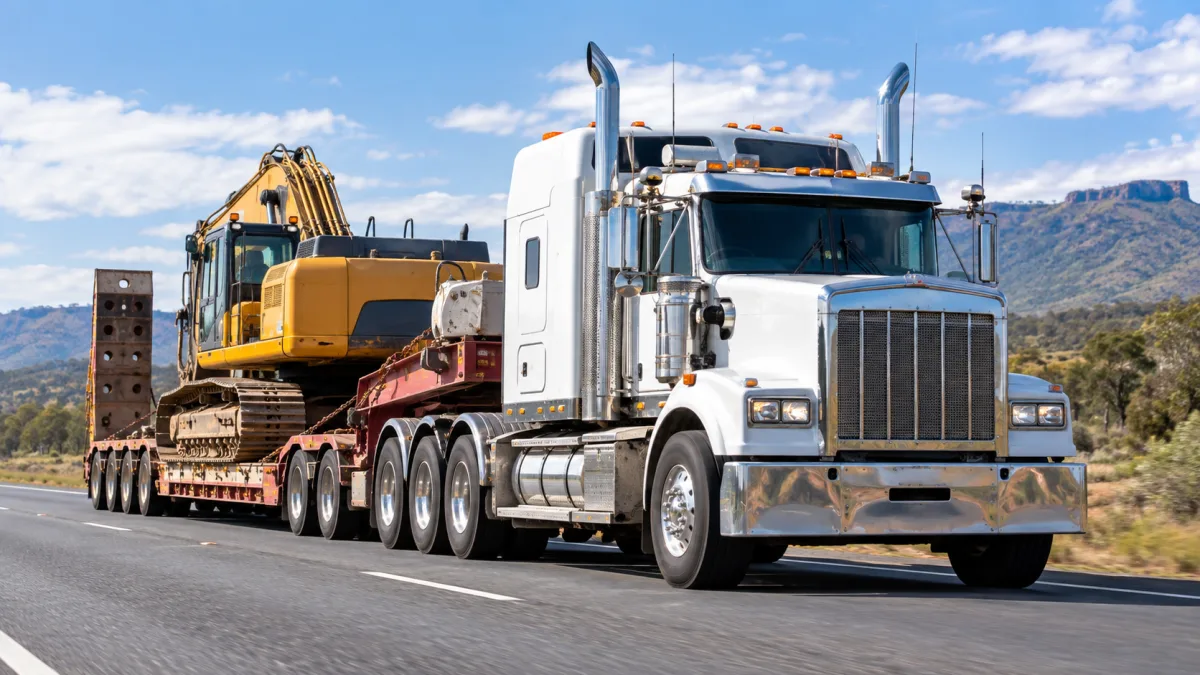

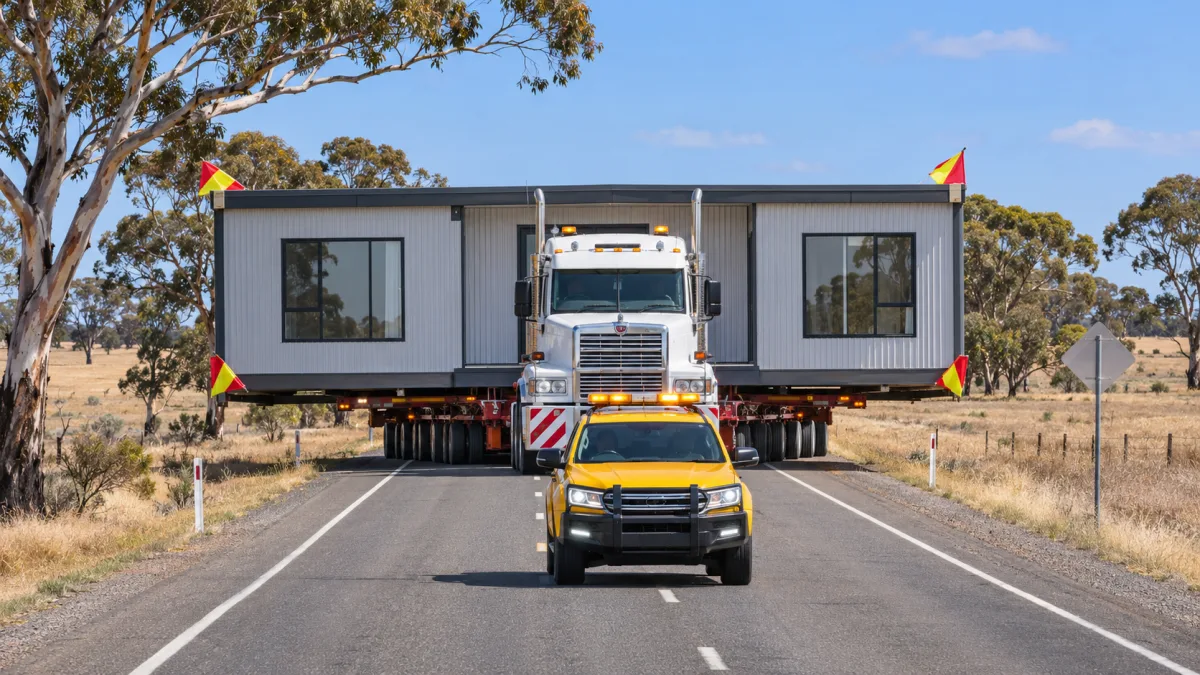
A prefabricated site office that's 3.2 metres wide, a bridge beam 28 metres long, an excavator that sits 4.7 metres high on the trailer. None of these can move like ordinary freight, and the rules that apply to them aren't one set of numbers. They're a series of thresholds, and each one adds something: a sign, a flashing light, a pilot vehicle, a restriction on when the truck can travel, a permit.
If you're the one shipping the load, you don't need to know every clause. You do need to know roughly where your freight sits against those thresholds, because that decides the cost, the timeline and how much notice your freight provider needs. Here's how the main thresholds work under the oversize load regulations in the eastern states and territories, and what to check elsewhere.
When Does a Load Become Oversize?
A heavy vehicle becomes oversize when it, together with its load, goes beyond the general dimension limits that apply to ordinary trucks. The general width limit is 2.5 metres, with a slightly wider allowance for some newer vehicles fitted with specific safety features. The general height limit is 4.3 metres, with 4.6 metres allowed for certain vehicles and networks. Length limits depend on the vehicle combination. Our post on the 2026 mass and dimension changes covers the recent increases to those general limits.
Once a load goes past them, the vehicle is generally treated as a Class 1 oversize vehicle. It can then only travel under a published notice, which sets conditions and approved networks, or under a specific permit.
The key point for shippers is that it's the vehicle and load together that's measured, not just your item. A 4.4-metre-high machine on a trailer deck that's a metre off the ground is a 5.4-metre-high vehicle.
The Width and Length Thresholds That Matter
These are the main thresholds under the Heavy Vehicle National Law and the NHVR's national notice for load-carrying vehicles. They're simplified here. The detailed conditions depend on the vehicle, the route and the state.
| Vehicle and load | What's generally required |
|---|---|
| Wider than 2.5 m, or longer than 25 m | Oversize warning signs and warning flags |
| Not wider than 2.5 m, but longer than 22 m (up to 25 m) | A warning sign at the rear of the vehicle or load |
| Wider than 2.5 m, or longer than 22 m | A warning light on the vehicle |
| Wider than 3.1 m, or longer than 22 m | Night travel restricted: not outside urban areas, and only with a pilot inside them, unless a state schedule allows otherwise |
| Wider than about 3.5 m, or longer than about 25 to 26 m | Usually a pilot vehicle (thresholds vary by state, see below) |
Oversize warning signs have to be at least 1,200 mm long and 450 mm high, and there are detailed rules for colours, borders, lights and flags. Getting those right is the operator's job, but it's useful to know they exist, because a properly signed and lit vehicle is part of what you're paying for.
Is "3 metres wide" a special number?
You'll often hear 3 metres mentioned as a cut-off. In practice there isn't one universal 3-metre rule. The thresholds that recur are 2.5 metres (signs, flags and lights start), 3.1 metres (night travel restrictions start) and around 3.5 metres (pilot vehicles typically start in most areas). South Australia's Adelaide Hills area is an exception, with a pilot required from 3.0 metres. Local conditions can add more.
Pilot Vehicle Thresholds by State
A pilot vehicle travels ahead of or behind the oversize vehicle to warn other road users. Under the NHVR's national notice for Class 1 load-carrying vehicles, the daytime thresholds for non-metropolitan areas are:
| Jurisdiction | Pilot generally required when longer than / wider than |
|---|---|
| ACT | 25 m / 3.5 m |
| New South Wales | 26 m / 3.5 m |
| Queensland | 25 m / 3.5 m (some low loader and extendable trailer combinations can reach 26 m on approved B-double or road train routes) |
| South Australia | 20 m / 3.0 m in the Adelaide Hills area; 26 m / 3.5 m in the Country Zone |
| Victoria | 26 m / 3.5 m |
Metropolitan areas, night travel and the largest loads have their own requirements. Very wide or long loads may need more than one pilot, and some need police or authorised escorts. Your freight provider works these out for the specific load and route.
The Upper Limits Under the National Notice
The NHVR's national dimension notice lets eligible load-carrying vehicles go well beyond general limits without an individual permit, on approved networks and subject to conditions. The maximums it allows are:
| ACT | NSW | QLD | SA | VIC | |
|---|---|---|---|---|---|
| Maximum laden width | 5.0 m | 5.0 m | 5.5 m | 4.6 m | 5.0 m |
| Maximum height | 5.0 m | 5.0 m | 5.0 m | 5.0 m | 5.0 m |
| Maximum length | 30 m | 30 m | 35 m | 30 m | 30 m |
One detail matters a lot for tall freight: a loaded vehicle higher than 4.8 metres has to carry the load on a deck no more than 1.2 metres above the ground. That's one reason tall machinery often travels on a low loader or drop deck rather than a standard flat-top.
Loads beyond these limits, or travelling on roads outside the approved networks, need a specific permit. That's usually applied for through the NHVR, with state road managers and sometimes local councils consenting to the route.
Western Australia, the Northern Territory and Tasmania
The national notice above applies in the ACT, New South Wales, Queensland, South Australia and Victoria. Western Australia and the Northern Territory run their own heavy vehicle systems, and Tasmania isn't covered by this particular notice. For oversize moves in or through those areas, the rules and permits come from the relevant state or territory authority, so check the requirements for the specific route rather than applying the figures above.
What Oversize Means for Your Booking
Time
Permits, route assessments and pilot bookings take time to arrange, and the larger the load, the longer it takes. Ask for an oversize quote as early as you can. Don't book the crane at the delivery site before the transport window is confirmed.
Travel windows
Many oversize loads can only travel in daylight, and some routes have curfews or restricted periods, including around peak traffic and some holiday periods. A trip that's a few hours' drive for a normal truck can take longer once travel windows are factored in.
Cost
The main cost drivers are the vehicle and trailer needed, the number of pilot vehicles, the route assessment and permit costs, and any restricted travel windows that stretch the trip. Small changes in dimensions can cross a threshold. A load that's 3.6 metres wide rather than 3.4 metres may need a pilot on routes where it otherwise wouldn't.
Route
The shortest road isn't always available. Bridges, overhead structures, roadworks and approved networks all shape the route, which is why oversize moves are surveyed before they go. Our guide to choosing a heavy machinery transport provider covers the questions to ask about route planning and permits.
What to Give Your Freight Provider
Accurate details at quote stage avoid most of the delays and re-quotes in oversize work:
- Length, width and height of the item itself, measured at the widest, longest and tallest points, including anything that sticks out.
- The weight, and where the heaviest part sits if it's uneven.
- Whether it can be dismantled. Removing a bucket, a canopy or a section can sometimes bring a load under a threshold.
- Pickup and delivery addresses, with photos of site access, overhead clearance and the unloading area.
- How it will be loaded and unloaded: crane, forklift, ramps or self-propelled.
- Your timing, including any fixed date at the delivery end, such as a crane booking.
Oversized Freight With Ozcoast
Our oversized loads service manages permits through the NHVR and state authorities, surveys routes before the load moves, and arranges certified pilot and escort vehicles where they're required. Extendable trailers, drop decks and low-loaders are matched to the load. For heavier moves, see our heavy haulage service.
Send us the dimensions, weight, addresses and timing, and we'll tell you where your load sits against the thresholds, what it will need, and how long to allow.
This is a general guide, not legal advice. The NHVR notices, and the requirements of each state and territory, are the source of truth for any specific move.