
You book the freight, the truck turns up, and someone hands you a document to check and sign before the goods go anywhere. Most people glance at it, sign, and move on. That document, the consignment note, is actually the legal record of what was handed over, in what condition, and under what terms, and it's usually the first thing anyone asks for if a delivery goes missing, arrives damaged, or turns up short.
Here's what's actually on it, why it carries more weight than it looks like it should, and the mistakes that turn a routine shipment into a dispute later.
What Is a Consignment Note?
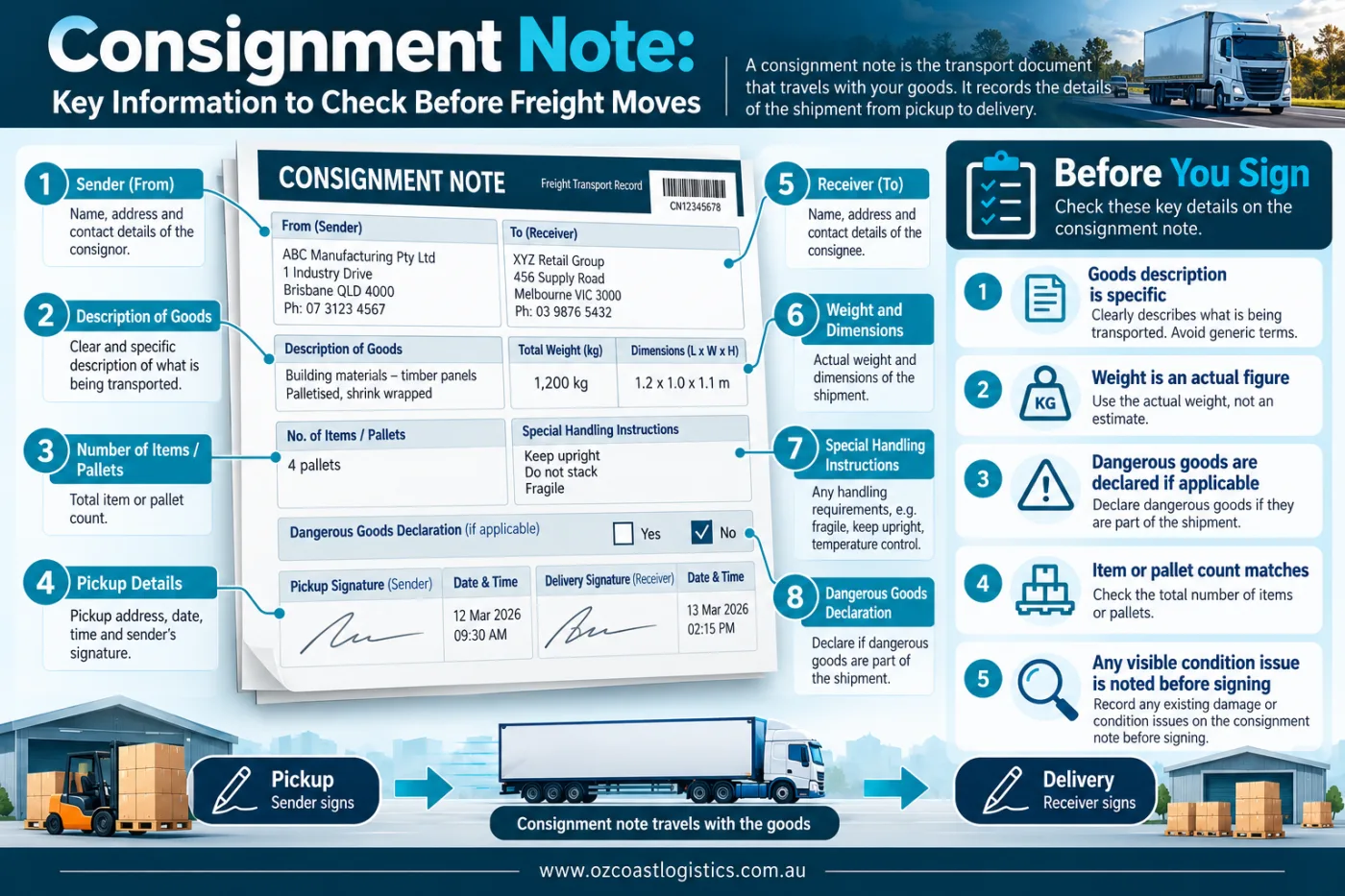
A consignment note is the document that accompanies a freight shipment and records the agreement between the sender (the consignor), the transport provider, and the receiver (the consignee) for that specific movement of goods. It's created when the freight is booked or collected, travels with the goods, and gets signed at both ends, once when the goods are picked up, confirming what was handed over, and again on delivery, confirming what arrived.
It's not just paperwork for its own sake. It's the primary evidence of what was actually shipped, whether it arrived in the same condition it left in, and who's responsible if something doesn't line up.
What Information Actually Goes On It
| Field | Why it's there |
|---|---|
| Sender and receiver details | Who's accountable at each end of the movement |
| Description of goods | What's actually being carried, not a vague summary |
| Weight and dimensions | Confirms the load matches what was quoted and booked |
| Number of items or pallets | A count both sides can check the delivery against |
| Special handling instructions | Fragile, this-way-up, temperature requirements, and so on |
| Dangerous goods declaration | Required if the shipment includes any, tied to Chain of Responsibility obligations |
| Pickup and delivery signatures | Confirms the handover happened, and what condition the goods were in at each point |
| Date and time stamps | Establishes the timeline if a delay or damage claim comes up later |
Every one of these fields exists because at some point, for someone, it was the detail that mattered when a shipment didn't go to plan.
Why It Matters More Than Most Businesses Realise
A consignment note is often the only independent record of what actually happened to a shipment. That makes it the starting point for a few things that matter more than they seem to at booking time:
- Proof of pickup and delivery. If a receiver disputes that something arrived, or arrived incomplete, the signed consignment note is usually the first thing checked.
- The basis for a damage or loss claim. Whether it's an insurer or the transport provider working out what happened, the consignment note is the record they start from, since it's the only document that describes the goods' condition at both the start and end of the trip.
- Evidence in a Chain of Responsibility context. If you're the consignor, an accurate consignment note is part of how you demonstrate you met your declaration obligations.
- The reference point for resolving disputes. If the weight or item count on delivery doesn't match what was recorded at pickup, the consignment note is what everyone works from to figure out where the discrepancy happened.
None of this matters until it does, and by then it's too late to fix a vague or incomplete note.
Consignment Note vs Other Freight Paperwork
A few terms get used interchangeably that actually mean different things, and it's worth being clear on which one applies to a domestic road freight booking:
- Consignment note: the document for a single domestic road freight movement, what most businesses booking freight within Australia will deal with.
- Waybill: used broadly across transport modes, sometimes interchangeably with consignment note, but more commonly associated with air freight.
- Bill of lading: the equivalent document for sea freight, issued by a shipping line or freight forwarder, not something a domestic road transport provider issues.
If a form you've been handed is called a waybill or a bill of lading rather than a consignment note, it's worth checking which leg of the journey it actually covers, since it may relate to an international shipment rather than the road transport itself.
Common Mistakes That Cause Problems Later
- A vague goods description. "General cargo" or "boxes" doesn't help anyone if a claim needs to be made later. Be specific.
- No weight recorded, or an estimate rather than an actual figure. This is also a Chain of Responsibility issue if you're the consignor.
- Missing a dangerous goods declaration when the shipment includes any, even in small quantities.
- Signing without checking. The signature confirms the goods were received in the stated condition. If something looks off, note it before signing, not after.
- No photo record. Not part of the consignment note itself, but a quick photo of the goods at pickup and delivery is the easiest way to back up what the note says if a dispute ever comes up.
A Quick Checklist Before You Sign
- Does the goods description actually describe what's being shipped, not just a generic category?
- Is the weight an actual figure, not an estimate?
- If dangerous goods are included, is the declaration filled in?
- Does the item or pallet count match what you're expecting?
- If anything about the condition of the goods looks off at pickup or delivery, has it been noted before signing?
How Ozcoast Handles This
We generate the consignment note as part of the booking, using the weight, dimensions and goods description you provide at quote stage, which is one more reason getting those details right upfront matters. It travels with the shipment and gets confirmed at both pickup and delivery, so there's a clear, accurate record if you ever need to look back at it.
If you're ever unsure what to write in the goods description field, or whether something needs a dangerous goods declaration, ask before the truck arrives rather than after. It's a two-minute question that saves a much longer conversation if something needs to be proven later. Contact Ozcoast Logistics for free consultation.