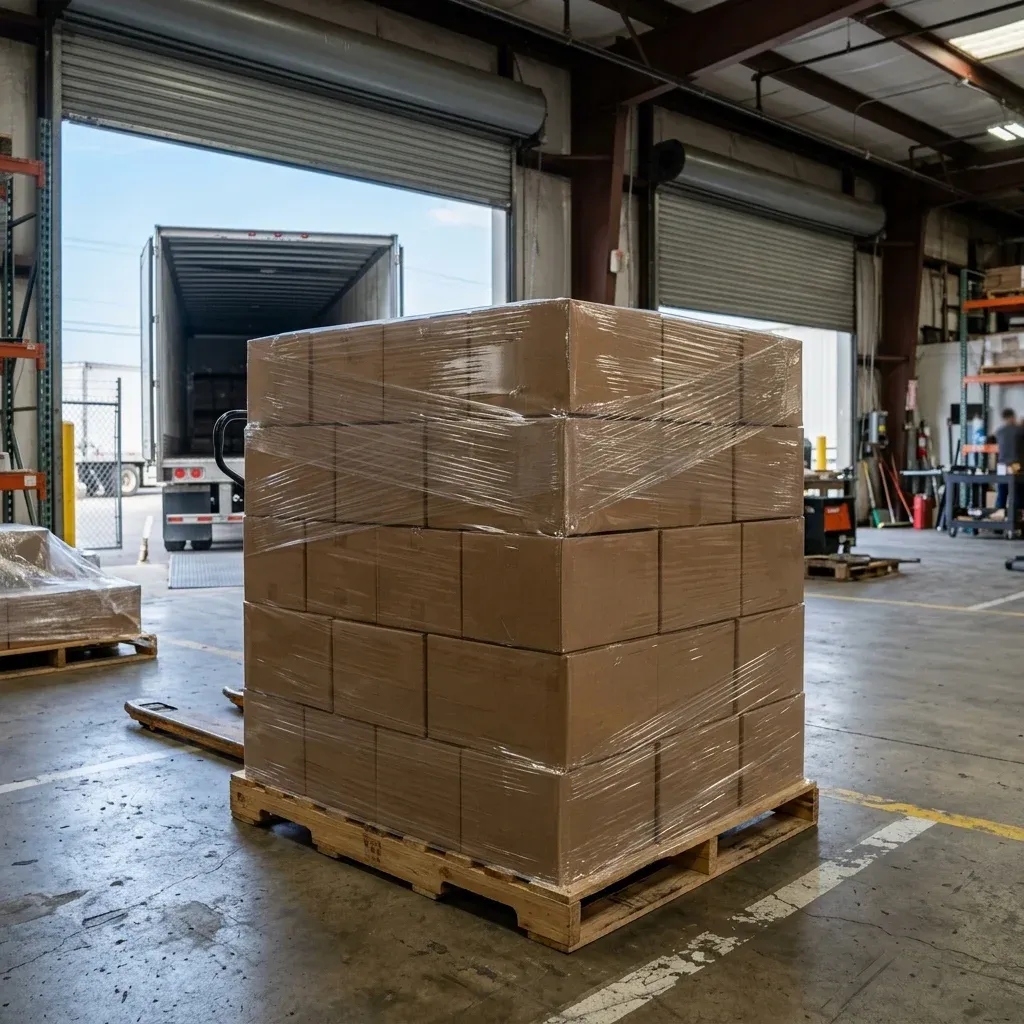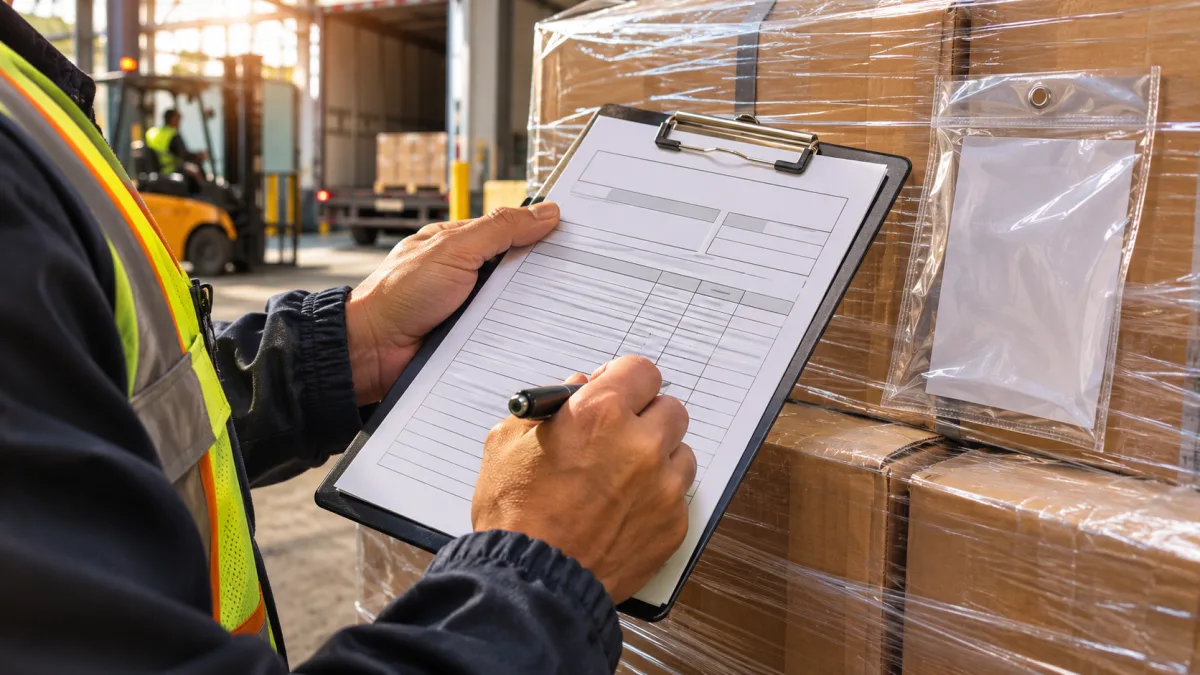

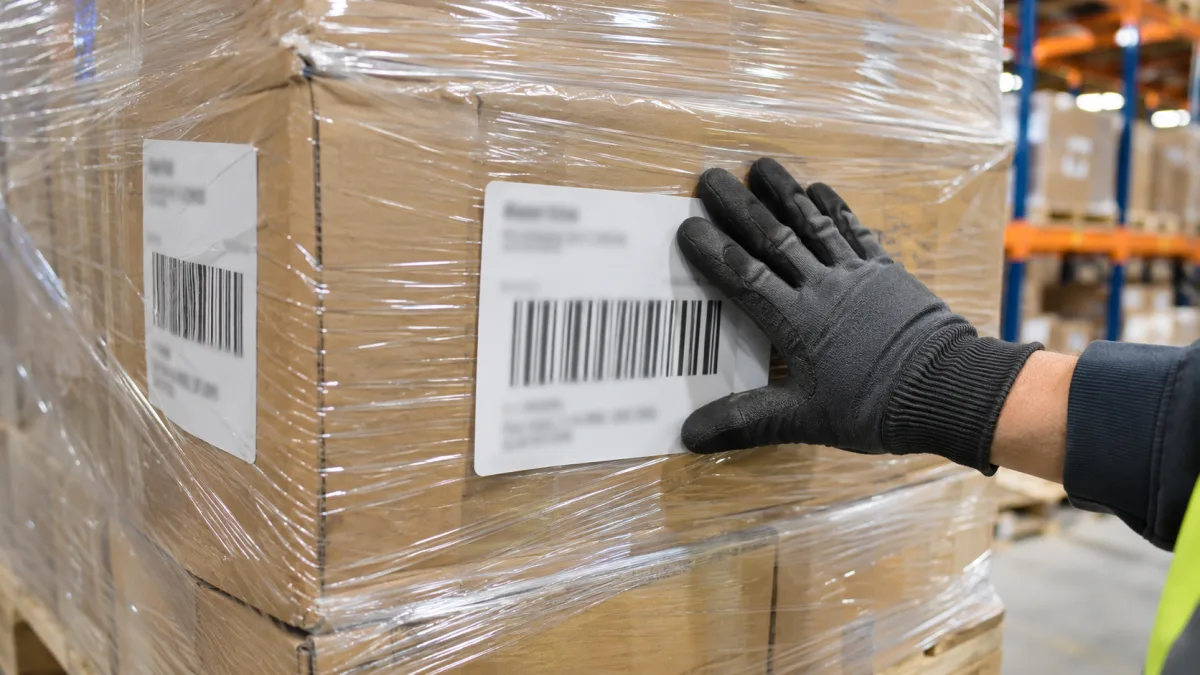
A pallet heading into a supermarket or large retail distribution centre usually carries three or four different pieces of paper and barcode. The truck driver cares about one of them. The receiving dock cares about another. If that second one is missing, on the wrong side or won't scan, the pallet can sit at the dock while everyone works out what it is.
That label is the SSCC label. Here's what it is, what's on it, where it goes, and how it fits alongside the freight paperwork you already deal with.
What Is an SSCC Label?
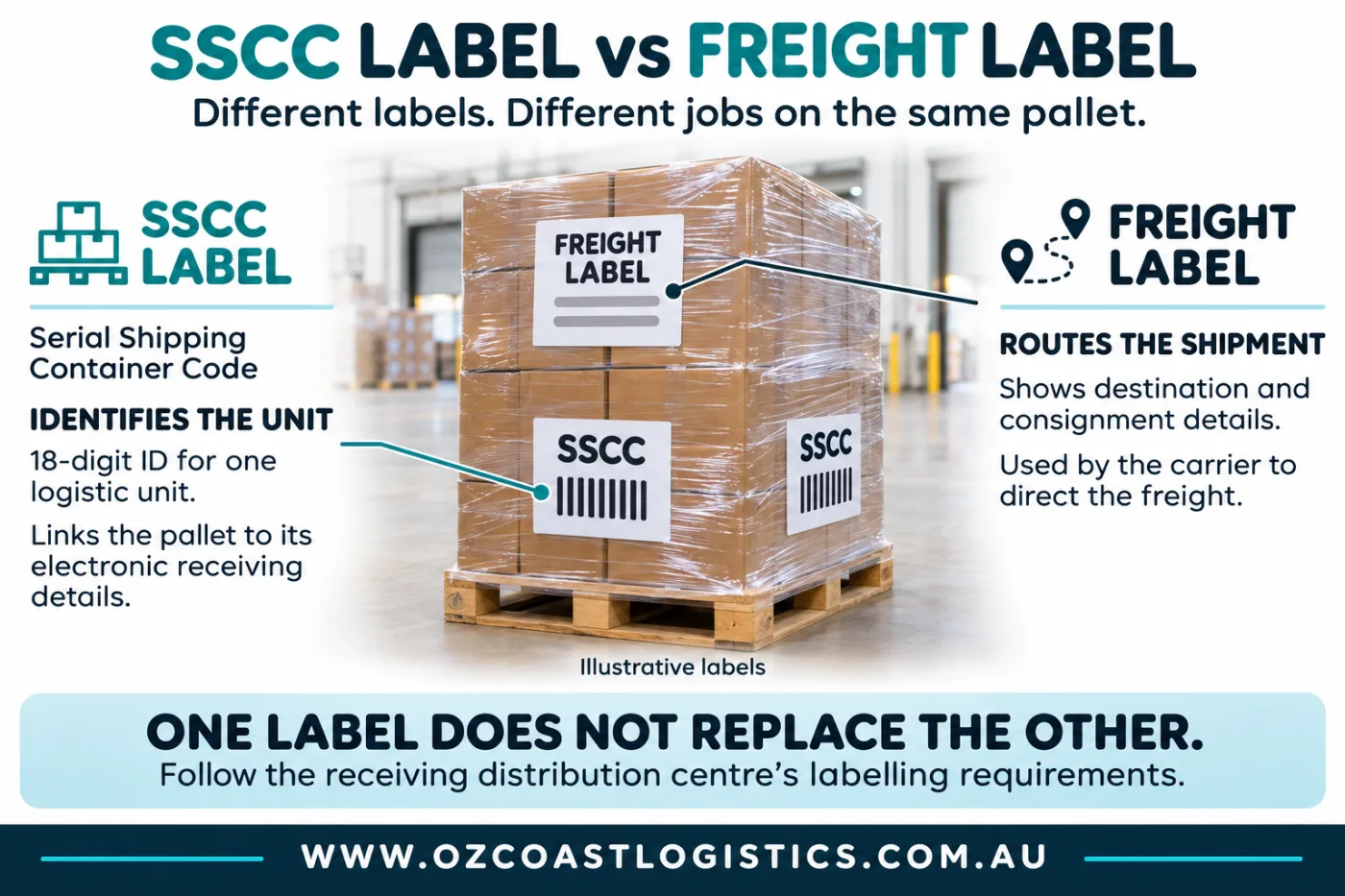
SSCC stands for Serial Shipping Container Code. Despite the name, it has nothing to do with shipping containers. In GS1 terms, a "shipping container" is any logistic unit: a pallet, a carton, a parcel or a shrink-wrapped group of goods put together for storage or transport.
The SSCC is an 18-digit number that identifies that one unit and no other. GS1 describes it as working like a licence plate. The SSCC label (GS1 calls it the GS1 Logistic Label) is the sticker that carries the number as a barcode and in human-readable form, along with any other information the receiver needs.
When the pallet is scanned at the receiving dock, the SSCC is what links that physical pallet to the electronic details about it: what's on it, how many, which order it belongs to.
What the 18 Digits Mean
Every SSCC is built the same way. Using GS1's own example number, (00) 1 6400001 123456788 6:
| Part | Example | What it is |
|---|---|---|
| Application Identifier | (00) | Tells the scanner the data that follows is an SSCC. Not one of the 18 digits. |
| Extension digit | 1 | A digit from 0 to 9 chosen by the company creating the SSCC, to extend the range of numbers available |
| GS1 Company Prefix | 6400001 | Allocated by GS1 to the brand owner or the business building the pallet. Seven to nine digits long. |
| Serial reference | 123456788 | Assigned by that business to make each unit unique. GS1 recommends starting from zero and counting up, with no meaning built in. |
| Check digit | 6 | Calculated from the first 17 digits, so a mis-scan or typo is caught |
Two rules matter in practice. The SSCC stays with the unit for its whole life, from the dock it leaves to the dock it arrives at. And an SSCC must not be reused within one year of the shipment date, so you can't print a batch of labels and recycle them every week.
SSCC vs the Other Labels on a Pallet
This is where a lot of confusion comes from. A pallet going into a DC might carry all of these:
| Label or document | Who creates it | What it's for |
|---|---|---|
| SSCC (logistic) label | The supplier or whoever built the pallet, using their GS1 Company Prefix | Identifies the pallet itself, so the receiver can scan it in and match it to the order |
| Product barcode (GTIN) | The brand owner | Identifies the product on each carton or item, not the pallet |
| Freight or consignment label | The carrier's booking system or the sender | Tells the carrier where the freight is going and links it to the consignment note |
| Delivery docket | The supplier | Lists what's being delivered for the receiver to check. Our guide to the delivery docket explains how it differs from the consignment note and invoice. |
| Handling marks | The sender | "Do not stack", "this way up" and similar instructions for whoever handles it |
The freight label gets the pallet to the right dock. The SSCC label gets it through the receiving process once it's there. Having one doesn't replace the other.
What Goes on an SSCC Label
The SSCC is the only element GS1 makes mandatory. In practice, most retailers want more, laid out in three blocks:
- Top block, free format. Usually the supplier's name and address, and sometimes a product description.
- Middle block, text with data titles. Plain-language versions of what's in the barcodes, such as SSCC, CONTENT, COUNT, BEST BEFORE and BATCH.
- Bottom block, the barcodes. GS1-128 barcodes with the numbers printed underneath. The SSCC always gets its own barcode, at the lowest position on the label.
For a pallet of a single product, GS1's example label carries the SSCC, the product's GTIN, the number of units, a best before date and a batch or lot number. A pallet of mixed products may carry just the SSCC, with the details sent electronically.
The A6 size (105 × 148 mm) is the most common label. Taller labels are used when there's more information to fit. A 2D barcode such as a GS1 DataMatrix or QR code can be added, but only alongside the GS1-128 barcodes, not instead of them.
Each retailer can set its own specifications on top of the GS1 standard, so check the supplier requirements for the DC you're delivering to.
Where the Labels Go on a Pallet
GS1 Australia's logistic label guidance for pallets is:
- Height: barcodes between 400 mm and 800 mm from the base of the pallet. For a pallet lower than 400 mm, place them as high as possible while keeping the label protected.
- Edges: no closer than 50 mm to any vertical edge, so the label isn't damaged by forklifts or wrap.
- Two labels: two identical labels on adjacent sides, ideally one on a short side and the second on the adjacent right-hand side.
- Orientation: barcodes in "picket fence" orientation, with the bars standing upright.
Woolworths states that two labels are required on every pallet delivered to its DCs. Label suppliers summarising the major grocery retailers' rules also describe placing labels on the fork-entry sides and a set distance in from the right-hand edge. Automated DCs scan pallets on the move, so a label in the wrong place can mean a pallet that doesn't scan.
How the SSCC Links to the ASN
Many large retailers expect an Advance Shipping Notice (ASN), also called a despatch advice, before the delivery arrives. It's an electronic message from the supplier listing what's coming, pallet by pallet, with each pallet identified by its SSCC.
When the truck arrives, the receiving team scans each SSCC. If it matches the ASN, the system already knows what's on the pallet, so receiving is quick and the goods can move straight into storage or across the dock. If the SSCC on the pallet doesn't match what was sent, or there's no ASN at all, the pallet has to be checked manually or held.
That's why getting the SSCC right isn't just a labelling job. The number on the pallet and the number in the ASN have to be the same.
Why Pallets Get Held or Rejected at a DC
Most problems come from a handful of mistakes:
- No SSCC label, or only one where two are required
- The same SSCC on two pallets, or a number reused too soon
- Labels on the wrong sides or at the wrong height, so automated scanners miss them
- Damaged, creased or poorly printed labels that won't scan
- Text or logos crowding the barcode and eating into the blank margin (the quiet zone) scanners need either side
- The freight label stuck beside the SSCC barcode instead of above or below it, which label suppliers say can cause rejects at automated DCs
- SSCCs that don't match the ASN, or pallets that were rebuilt after labelling
- Pallets built differently from the retailer's specification, for example mixed products on a pallet that should be single product
A held pallet can also cost you a missed slot. Distribution centres run booked delivery windows, and a truck delayed while pallets are sorted out may end up with waiting time charges. Our guide to demurrage and waiting time explains how those are charged.
Who Is Responsible for the SSCC?
The business that builds the pallet, usually the supplier or brand owner, is responsible for the SSCC. It's created with that business's GS1 Company Prefix, which comes with GS1 membership. GS1 Australia offers a labelling tool for smaller businesses, and label and printer suppliers sell software for larger volumes.
The carrier doesn't create the SSCC and can't fix a wrong one on the road. What the carrier needs from you is the freight label, the consignment details, the delivery booking reference and the DC's slot time. If a third-party warehouse builds and labels your pallets, it needs your GS1 details to create SSCCs on your behalf.
A Checklist Before the Truck Arrives
- Confirm the DC's supplier labelling requirements, not just the GS1 standard
- Build each pallet to the retailer's specification and wrap it before labelling
- Print SSCC labels clearly, on the right size label, with a fresh SSCC for every pallet
- Apply two identical labels on adjacent sides, 400 to 800 mm from the base and clear of edges
- Put the freight label above or below the SSCC label, not alongside the barcode
- Send the ASN with matching SSCCs before the truck leaves
- Book the delivery slot and give the carrier the booking reference and time window
- Keep the delivery docket with the freight, and see our pallet packaging guide for building a pallet that arrives intact

Delivering to Distribution Centres With Ozcoast
Our pallet delivery service runs regular pallet deliveries to stores, depots and distribution centres, and our team works with DC bookings, time slots and retail delivery requirements every day. Give us the DC, the booking reference, the slot time and the pallet details, and we'll plan the pickup and linehaul around the window.
If you need help before the freight leaves, our warehousing and distribution service covers fulfilment from inbound receipting and labelling through to picking, packing and dispatch.